Abu Simbel is a genuinely worthwhile add-on to a Nile cruise for most travelers, but it does mean a long day: the site sits roughly 280 kilometers south of Aswan on the shore of Lake Nasser, reached either by a road trip of three to three and a half hours each way with a very early departure, or by a short domestic flight that takes well under an hour in the air. It isn't part of any standard Luxor-Aswan cruise itinerary because the Nile itself doesn't run that far south — Abu Simbel sits on Lake Nasser, the reservoir created by the Aswan High Dam, not on the river the ships sail.
What Makes Abu Simbel Different From Everything Else on the Cruise
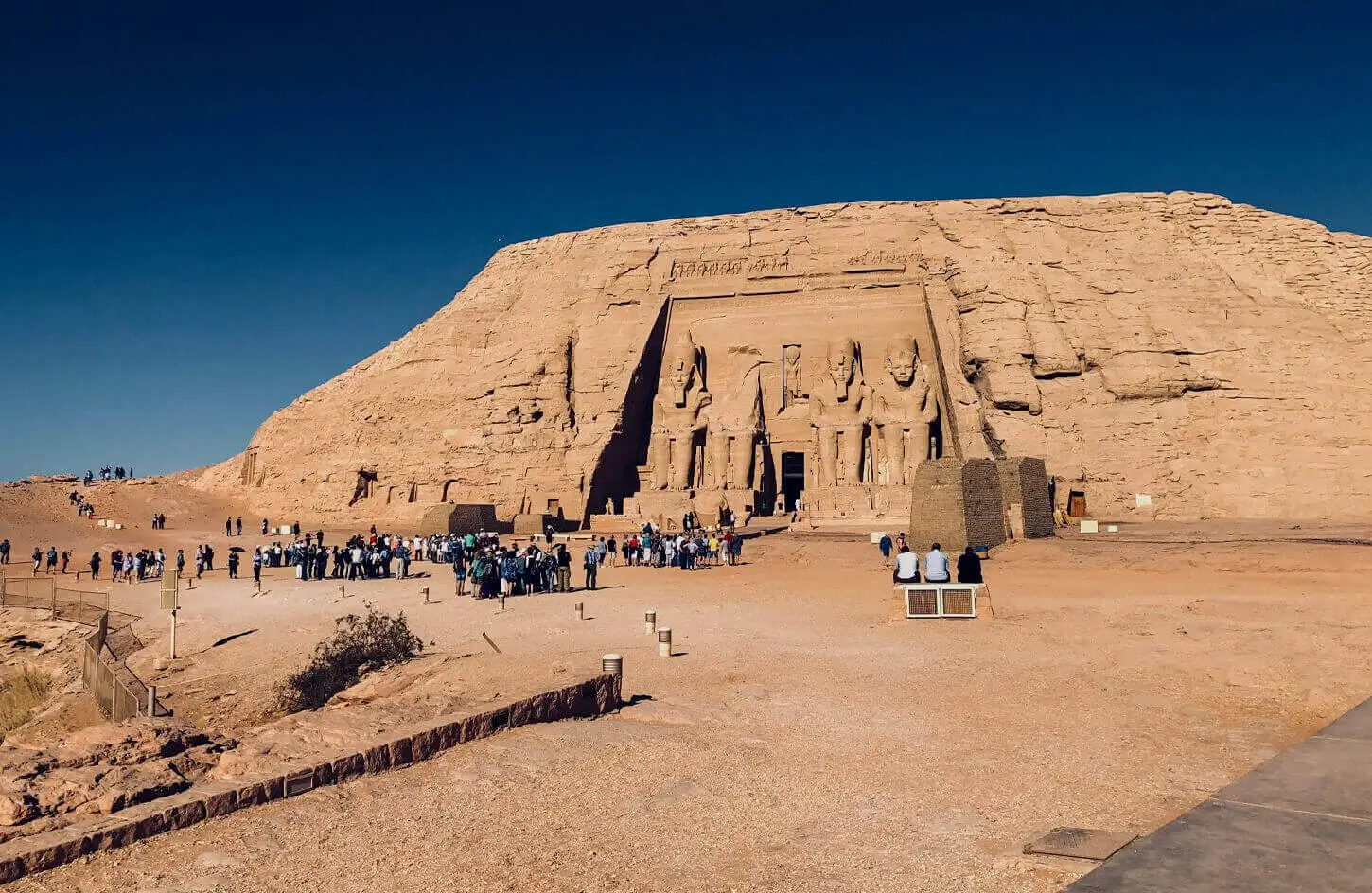
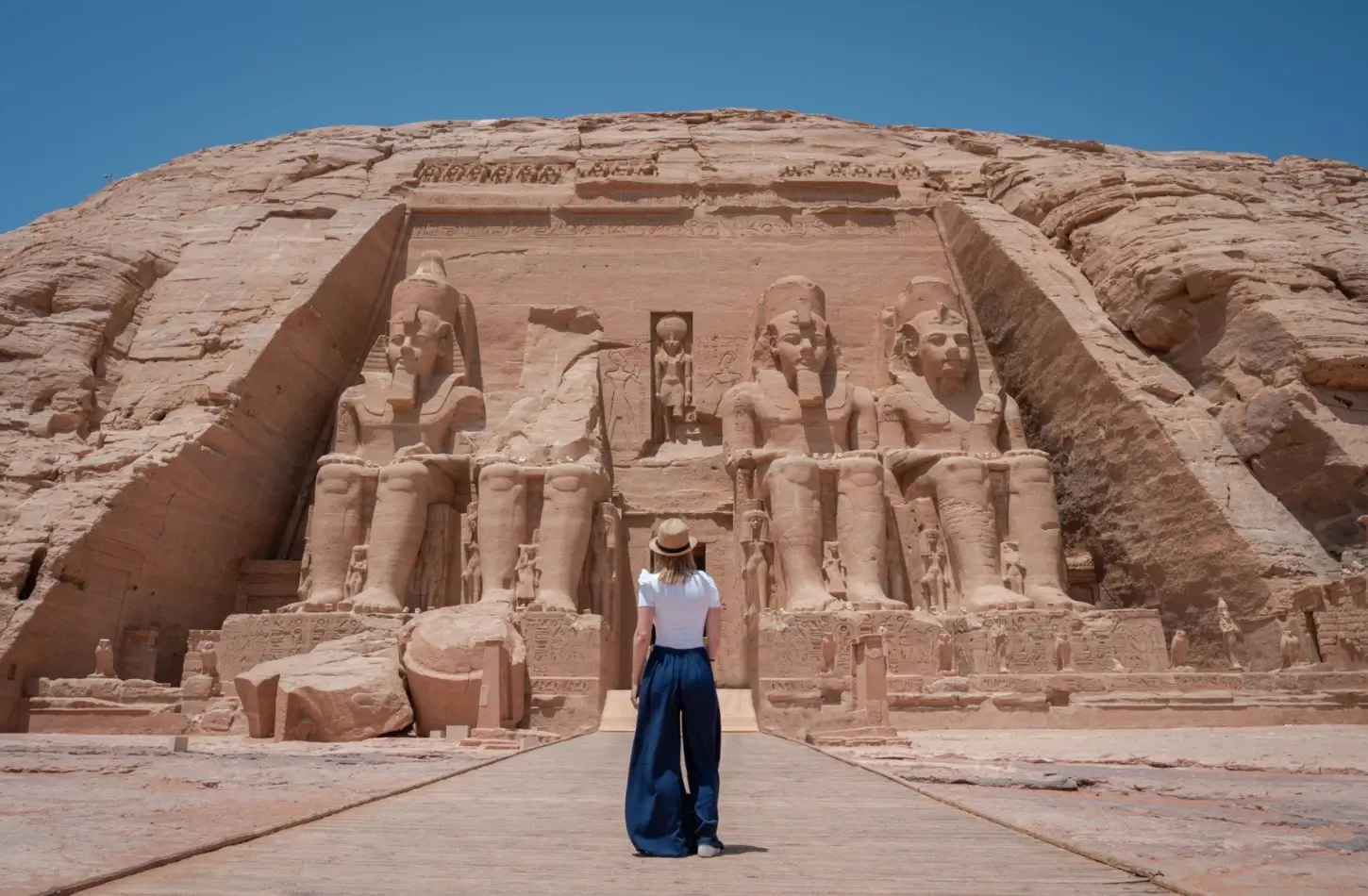
Every other major stop on a Luxor-Aswan cruise — Karnak, Luxor Temple, Edfu, Kom Ombo, Philae — sits directly on the Nile, which is why a cruise ship can simply dock nearby. Abu Simbel is the exception. Ramesses II built two rock-cut temples here in the 13th century BC, partly as a monument to himself and the gods Ra-Horakhty, Amun, and Ptah, and partly as a statement of Egyptian power aimed at Nubia and neighboring Kush to the south. The Great Temple's facade is dominated by four colossal seated statues of Ramesses II, each around 20 meters tall; a smaller, adjacent temple is dedicated to his wife Nefertari and the goddess Hathor — one of the very few ancient Egyptian temples where a queen is honored on the same visual scale as the king.
What makes the site remarkable today isn't just its age — it's that the entire complex was moved. When the Aswan High Dam was built in the 1960s and Lake Nasser began to fill, both temples sat directly in the path of the rising water. Between 1964 and 1968, an international UNESCO-led rescue project cut the temples into large blocks, lifted them out of the original cliff, and reassembled them on higher ground nearby — recreating the original orientation so precisely that the site's famous solar alignment still works.
Why Ramesses II Built So Far South
The location wasn't an afterthought. Ramesses II reigned for around six decades and built more monuments across Egypt and Nubia than almost any other pharaoh, but Abu Simbel sat at what was effectively the southern frontier of the Egyptian-controlled world in his era, close to the border with Kush. The scale of the facade — four seated colossi roughly 20 meters tall, dwarfing the human figures carved at their feet — was a message aimed as much at travelers and envoys arriving from the south as it was an act of religious devotion. It's worth having your guide point out the smaller figures carved between and beside the giant statues: these represent Ramesses II's family, including several of his many children, tucked into the scale of the monument almost as an afterthought next to the pharaoh's own image.
The smaller Temple of Nefertari, standing beside the Great Temple, is easy to undersell in comparison but is historically significant in its own right. Queens were traditionally depicted at a fraction of the pharaoh's scale in Egyptian art; here, Nefertari's statues stand at the same height as her husband's, an unusually direct statement about her status and the affection Ramesses II is recorded as having held for her.
The Sun Festival: A Reason to Time Your Visit
Twice a year, on February 22 and October 22, sunlight travels down the Great Temple's long entrance corridor at dawn and illuminates three of the four statues seated in the inner sanctuary — Ramesses II, Ra-Horakhty, and Amun — while the fourth, Ptah, the god associated with darkness, stays in shadow. The alignment happens for roughly twenty minutes starting around sunrise. These dates mark, according to most accounts, the anniversaries of Ramesses II's coronation and his birthday. It's a striking demonstration of how precisely the temple's original architects (and the 1960s engineers who relocated it) calculated the geometry — and if your cruise dates happen to line up with late February or late October, it's worth checking whether a Sun Festival departure is available, since it draws crowds and sometimes special early access.
Road Trip vs. Flight: How the Two Options Actually Compare
By Road
- Departures are typically very early — often before dawn, around 4:00 am — both to reach the site before the worst midday heat and to allow a same-day return.
- The drive covers about 280 km of open desert highway and takes roughly three to three and a half hours each way, usually with one short rest stop along the route.
- Police checkpoints remain along the road, though the strict escorted convoy system once used for this route is no longer how the trip typically runs.
- This is the more common and generally more affordable option, and it's what most standard and deluxe cruise add-on packages offer.
By Air
- Aswan's airport is a short taxi ride from the city center, and Abu Simbel's small airport sits close enough to the temples that the transfer on arrival is brief.
- The flight itself is short — well under an hour in the air — but once you add check-in, security, and transfers on both ends, the full door-to-door journey isn't dramatically faster than driving.
- Flying costs more but saves you from a pre-dawn wake-up and roughly six to seven hours of round-trip desert driving, which matters if you're already tired from days of early cruise excursions.
What a Typical Day Looks Like
- Very early wake-up — whichever option you choose, this is not a relaxed morning; road travelers in particular should expect a hotel or ship pickup well before sunrise.
- Arrival at the temples — a guided walk through the Great Temple's facade and interior halls, followed by the smaller Temple of Nefertari next door.
- Free time near the site — most itineraries build in some time to walk around the lakeshore and take in the view before heading back.
- Return to Aswan — by early-to-mid afternoon if you flew, or by afternoon/evening if you drove, usually in time to rejoin your ship before it departs Aswan or the next morning if it's an overnight add-on.
Is It Worth Adding to Your Cruise?
For most first-time visitors to Egypt, yes. Abu Simbel is one of the most recognizable ancient sites in the world, the rescue story adds a layer of modern engineering history most travelers find genuinely fascinating, and it's meaningfully different in character from the temples along the Nile itself — bigger statues, a starker desert-and-lake setting, and far fewer signs of the modern city crowding in around it. The trade-off is real, though: it's a long day bolted onto an already full cruise schedule, and if you're someone who struggles with very early starts or long drives, the fatigue is worth weighing against the payoff.
If you're short on time or budget, it's a reasonable site to skip — nothing about a standard Nile cruise itinerary requires it, and Philae Temple and the High Dam back in Aswan cover similar historical ground (the flooding of Nubia, the dam's engineering) in a half-day rather than a full one.
Booking It Alongside Your Cruise
Abu Simbel is almost always sold as an optional excursion rather than a built-in stop, since it isn't on the river route itself. It's worth asking about when you book so it can be scheduled around your ship's time in Aswan rather than added as an afterthought. Take a look at Egypt Cruise Trips' Nile cruise itineraries to see which sailings include Aswan overnight stays long enough to fit an Abu Simbel add-on comfortably, whether you're booking a standard, deluxe, or luxury sailing.